If your commercial metal roof is leaking, rusting, or overheating, the usual response is to keep patching it and hope the next fix holds.
The problem is patch repairs rarely address what’s actually failing. They focus on the visible issue, not the condition of the roof as a whole, which is why leaks tend to return, often in new places.
Assess the roof properly, then restore it if it’s still structurally sound or replace it if it isn’t - patching rarely holds up long term.
Australia is a tough place for metal roofs. Large temperature swings, intense UV, heavy rains, and long dry periods all place constant stress on roofing systems. Over time, it’s not the metal sheets themselves that usually give out; it’s everything around them that was never designed to cope with that level of movement and exposure forever.
All metal roofs expand and contract. That’s normal. But in Australia, wider temperature swings - cold nights, hot days, and seasonal extremes - cause roof sheets to constantly shift. That repeated movement puts stress on fixings, joins, and sealed connections. Over years of expansion and contraction, even well-installed roofs begin to open up at these points. The metal sheets themselves are often still sound, but the roof is no longer watertight.
UV exposure in Australia is relentless. Australia regularly records UV Index levels in the extreme range (above 11), among the highest in the world. Over time, it slowly breaks down sealants, coatings, and flashing materials, particularly those not designed to stay flexible long term. As these materials harden, crack, or lose adhesion, the roof’s ability to keep water out is compromised, even though the sheets themselves may still be intact.

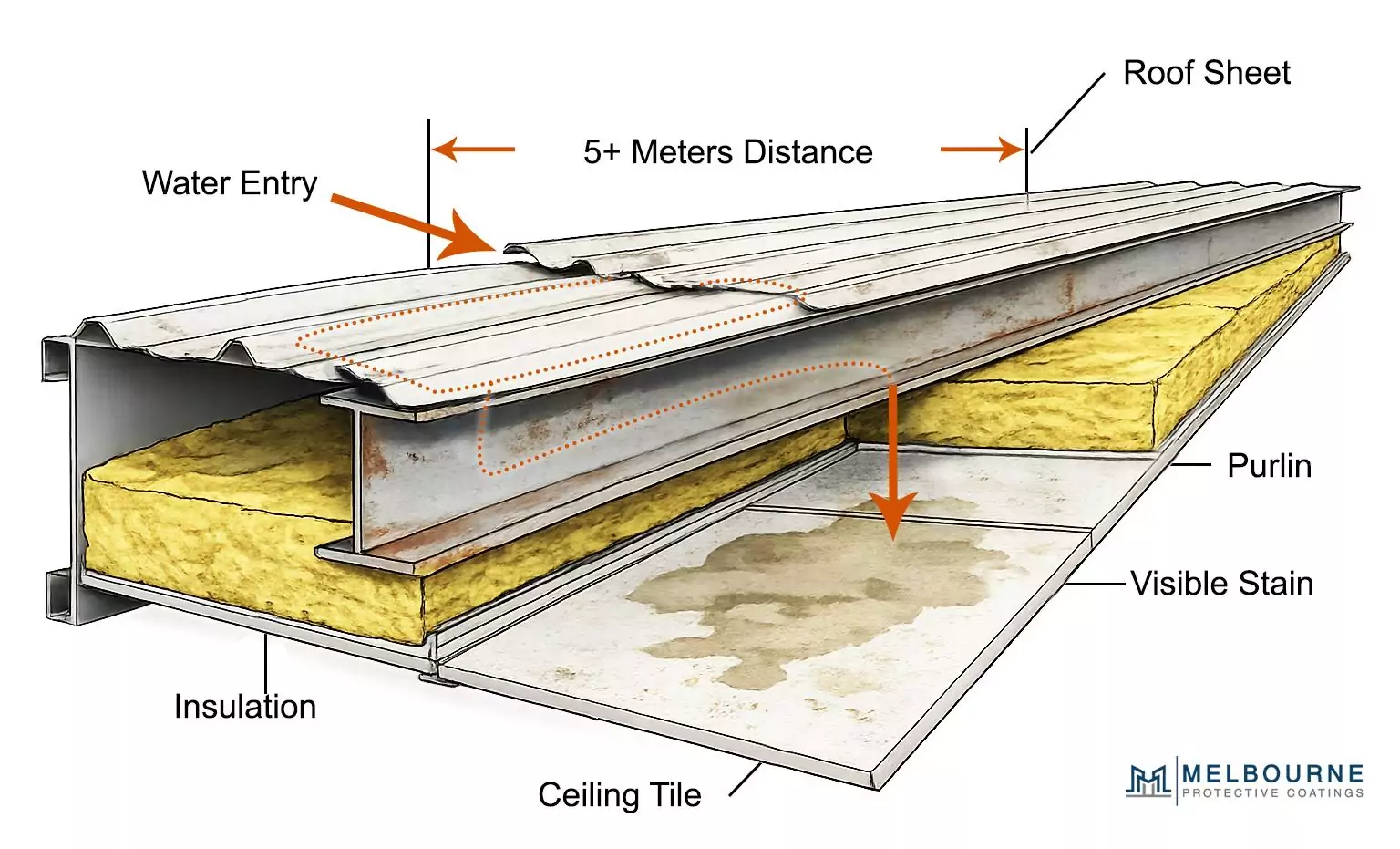
When a commercial metal roof starts leaking, the water stain you see inside is rarely where the problem began. Water can travel long distances across roof sheets, under laps, and along structural members before it shows up.
Rust often draws attention to a leaking roof, but it’s rarely the starting point.
In most cases, the real issue is water getting in somewhere else and being treated at the visible symptom instead of the entry point.
This is why many roofs keep leaking even after multiple “repairs.” So, where do leaks usually come from?
Box gutters are one of the most common sources of commercial roof leaks.
They carry large volumes of water, collect debris, and experience constant wet–dry cycles. Over time, movement, UV exposure, and ponding stress the joints, corners, and outlets. Once these areas open up, water backs up and finds its way inside the building.
Because box gutters sit lower than the surrounding roof, even small failures can lead to significant leaks during heavy rain.
Every penetration through a roof is a potential leak point.
Services like Air con, HVAC units, vents, pipes, and cable trays all interrupt the roof surface. These areas rely heavily on sealants, flashings, and flexible detailing to stay watertight. As movement and UV exposure take their toll, those materials break down.
Leaks around penetrations are often intermittent, making them hard to diagnose and easy to misidentify.
Metal roofs aren’t one continuous surface. They’re made up of multiple sheets and components, with overlaps and terminations that rely on fixings, sealants, and detailing to stay watertight.
As those materials age, they lose flexibility and adhesion. Small gaps open up, allowing wind-driven rain to be pushed in or track underneath the sheeting. These failures are rarely obvious from ground level, which is why they’re often missed during quick inspections.
Once water gets into the roof system, it doesn’t drop straight down. It can travel along sheet profiles, follow purlins or other structural members, and move well away from the original entry point.
By the time water shows up inside the building, it may be several metres from where it actually got in - which is why sealing the visible leak spot almost never solves the problem.
At this point, it’s clear finding the real entry point matters.
But even when the source of a leak is correctly identified, spot repairs still fail far more often than you’d expect. That’s because the problem is not just where the water gets in; it’s the repair approach itself.
A spot repair treats a single point in isolation. It assumes the visible failure is the only failure, and that everything around it is still sound.
On commercial roofs, that’s rarely the case. Movement, UV exposure, and age affect entire sections of the roof at once. Fixing one join or one penetration doesn’t address the condition of the surrounding details that are under the same stress.
Even experienced contractors are making educated guesses when they patch one area at a time. Sometimes they get lucky. Other times, they don’t.
Metal roofs don’t stop moving once a patch is applied. They continue to expand and contract every day.
Under that constant movement - combined with UV exposure - silicone gradually hardens, loses adhesion, and starts to pull away at the edges.
When that happens, the repair doesn’t usually fail in the middle. It fails just beside it. New gaps open up next to the patched area, allowing water to get back in.
From the outside, it looks like the original repair “didn’t work.” In reality, the repair did exactly what silicone is capable of. It just isn’t designed to move with a roof long term.
Spot repairs create a cycle.
Each leak is treated as a new issue, even though it’s part of the same underlying failure pattern. Over time, call-outs become more frequent, downtime increases, and costs add up without ever addressing the roof as a whole.
This is why many commercial roofs are patched repeatedly for years before a different approach is considered.
Once patch repairs stop delivering results, the roof reaches a clear decision point. Delaying action might feel safer in the short term, but it allows deterioration to continue and limits better options later.
At that stage, there are only two real ways forward for a commercial metal roof.
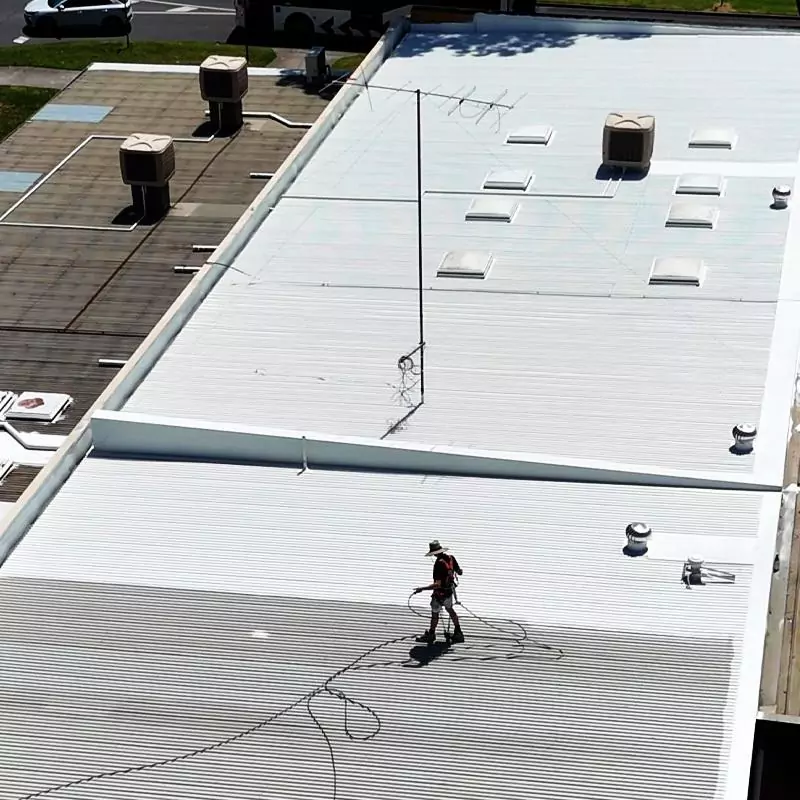
Roof restoration is about stabilising the roof as a whole, not chasing individual leaks.
Instead of sealing one failure at a time, restoration focuses on addressing the roof as a system. This typically involves:
Unlike rigid sealants or patch materials, a membrane remains flexible over time. That flexibility allows it to bridge joints, accommodate movement, and protect vulnerable areas without cracking or pulling away.
Waterproofing and rust protection work together with the membrane to stop water ingress and slow deterioration, rather than just masking symptoms.
When the roof sheets and structure are still sound - including cases where the roof remains safely walkable - restoration can significantly extend service life and restore reliability.
There are times when replacement is the right call. This is when:
In these situations, repairing or restoring the existing roof isn’t viable.
Replacement is a full “reset” where the existing roof is removed and a new system is installed. It comes with higher upfront costs, significant disruption, and longer downtime.
A new roof isn’t maintenance-free, though. Like any commercial roof, its long-term performance still depends on correct detailing, allowance for movement, and ongoing upkeep.
For these reasons, replacement should be used only when it’s genuinely required, not simply because patching has become frustrating.
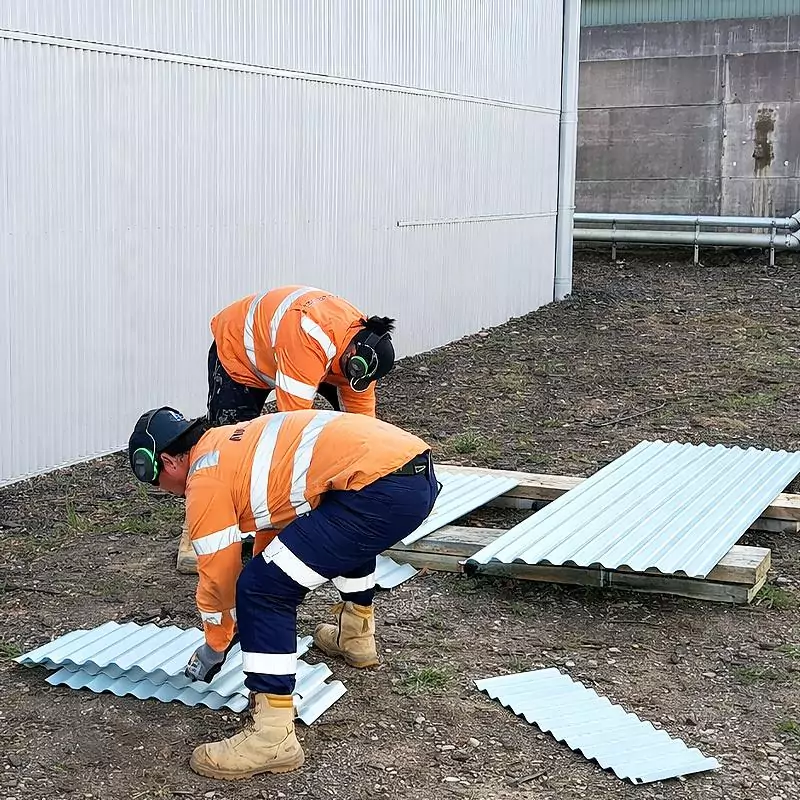
Which choice makes sense for your roof? It depends on the condition, risk, and what you need the roof to do from this point forward.
Is the roof’s structure still sound?
If the sheets, purlins, and supporting elements are structurally intact, restoration is possible. If there’s widespread structural damage or heavy corrosion, replacement becomes the safer call.
This is why a proper inspection matters. Cosmetic rust and surface deterioration don’t automatically mean the roof has reached the end of its life.
Surface rust and structural corrosion are two very different things.
Surface corrosion and early-stage rust can often be treated and stabilised as part of a restoration system. When caught early, the metal is still doing its job, and protection can slow or stop further deterioration.
Advanced corrosion is different.
It shows up as section loss, thinning steel, flaking, or rust that has spread through critical areas like laps, fixings, gutters, or structural elements. At that point, the material itself is weakened, not just the surface.
The key question is whether corrosion can be arrested and protected, or whether it has progressed to the point where the roof can no longer be relied on structurally. That distinction is what separates restoration from replacement.
Restoration and replacement carry very different levels of disruption.
Restoration is typically less invasive, faster to complete, and allows buildings to remain operational during works. Replacement often requires larger shutdown windows, more access restrictions, and greater coordination.
For facilities where downtime is costly or disruptive, this factor alone can heavily influence the decision.
Replacement has a higher upfront cost. But in some cases, it’s the only way to reset a roof that has deteriorated too far.
Restoration is usually more cost-effective upfront and can deliver strong long-term value when applied to a roof that’s still structurally sound. The key is understanding what outcome you’re buying and how long you expect the roof to perform.
| When To Restore | When To Replace |
|---|---|
|
|
Every commercial roof is different, but the principles behind effective protection are consistent.
Rather than basing decisions on how bad a leak looks at any given moment, MPC looks at the condition of the roof system as a whole, including movement, detailing, corrosion, and structural integrity. Similar symptoms can sit on very different underlying conditions, which is why the right approach isn’t obvious without proper assessment.
With that in mind, MPC groups its work into three practical approaches. These aren’t ranked solutions or preset packages. They reflect different protection strategies, selected based on how the roof is performing and what it needs to do next.
This approach focuses on membrane-based waterproofing to stabilise vulnerable areas, manage ongoing movement, and slow further deterioration.
It’s typically suited to owners who are acting early, while the roof is still sound and before small issues have the chance to escalate.
This approach concentrates on higher-risk details such as penetrations, box gutters, ridge caps, and terminations, addressing them using a whole-roof logic rather than isolated fixes.
It’s selected when targeted intervention can restore reliability without escalating to more invasive work.
This approach includes more comprehensive treatment of sheet joins and vulnerable interfaces to provide an additional margin of protection where simpler measures may not be sufficient.
It’s applied selectively, based on roof condition, not as a default response.
Once a membrane system is in place, the roof no longer needs to be reworked from the ground up each time protection is renewed.
Because the preparation and detailing already exist, extending the system typically involves far less work than the original installation. That’s what allows service life to be extended over time, without repeating the same level of cost or disruption.
Most commercial metal roofs don’t fail all at once. Problems build gradually, often long before leaks become disruptive.
The key is to understand what stage your roof is at, and choose an approach that fits its condition, risk, and remaining service life.
When that decision is made with clear information, owners regain control over timing, cost, and disruption. When it’s left too late, the roof tends to make the decision for them.
When the condition of the roof is clearly understood, the next step usually becomes obvious.